

On behalf of our team at Zenith Dental Care, we would like to thank you for taking the time to review our site. At ZDC, we take pride in our compassionate, caring and funenvironment. We would like to welcome you to our Zenith family.
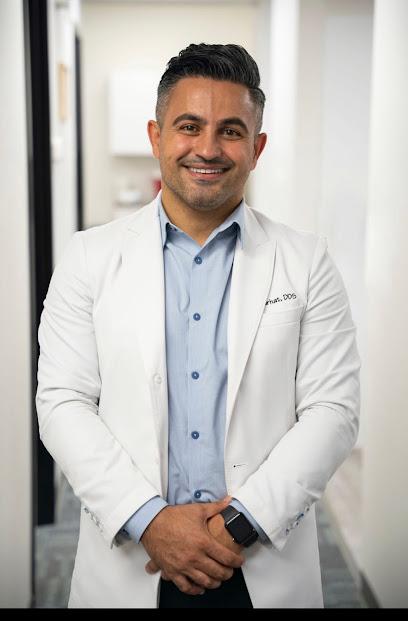
Why Dearborn?Dr. Farhat was raised in Dearborn, MI where he attended O.L. Smith Middle School, and Dearborn High School. Furthermore, Dr. Farhat continues to reside in the city of Dearborn. Upon completing his dental education at The University of Michigan-Ann Arbor, Dr. Farhat wanted to return to his hometown to give back high quality dental careto thecommunity.
At our core, webelievein education. AtZenith Dental Care, educating our patients about their oral health is our primary mission. An educated patient that is able to make informed decisions about their oral health is the best patient.
Since entering dental school, Dr. Farhat has always strived for the highest level ofquality dental care. Dr. Farhatattended theUniversity of Michigan-Dearborn where he completed a Bachelor's degree inBiology. He then went on to theUniversity ofMichigan-Ann Arbor where hecompleted a one year Master's degree inHuman Physiology as well as attaininghisdental education atthe University ofMichigan School of Dentistry.
Whenever Dr. Farhat is not in the clinic caring for his patients, he is spending time with his wife Nada and their newadditionto the family, baby Jenna. Furthermore, Dr. Farhat enjoys outdoor activities as well as working andrestoring vehicles at hisfather's auto repair shop.
Crowns and bridges? Do you know the difference between these two dental prosthetics? They are great ways to protect and preserve smiles damaged by decay, gum disease and tooth loss. Read here about these common restorative treatments and their outstanding results.
The answer is no, because nothing looks, feels or functions quite like a natural tooth. Plus, when you lose a tooth, your jaw bone and gum tissue naturally begin to recede. The more teeth you lose, the more aged your facial appearance becomes, and the harder it is to bite and chew properly. In other words, keep your own teeth as long as possible.
After root canal therapy, a removal of extensive decay, or oral trauma (tooth fracture), a beautiful dental crown from Zenith Dental Care may be just what you need to protect and beautify your tooth. Usually, crowns are made of precious metals, such as gold, porcelain or porcelain fused to metal. They cover teeth from the gum line to the very top.
Zenith Dental Care will examine the tooth in question and X-ray it to see if a crown would be suitable. If so, he'll take an oral impression and remove the damaged tooth enamel and/or old filling material. This process usually requires nothing more than a local anesthetic to numb the area around the tooth. He'll place a temporary restoration and send instructions to his preferred dental lab. At the lab, a trained technician fabricates a customized crown with just the right shape and color for your smile.
On your return visit, Zenith Dental Care will remove the temporary crown and bond the permanent one in place. He takes the time to ensure it bites together with the opposing arch perfectly and does not crowd surrounding teeth.
You'll find your dental crown feels natural and looks great. Just care for it as you would your other teeth, brushing and flossing daily and coming to Malouf Family Dentistry for your check-up and professional cleaning. It should last you ten years or more!
Bridges are comprised of artificial teeth, or pontics, attached to neighboring natural teeth (abutments) via dental crowns. As with the crown procedure, Zenith Dental Caredoes a comprehensive oral exam and takes impressions. His treatment plan tells the lab precisely how to make the bridgework.
Because the appliance involves crowns, the dentist prepares the abutment teeth by removing some enamel. This process ensures the bridgework will be properly supported and stay in place for its expected lifespan of ten years (according to the Cleveland Clinic).
About Oral Surgery in DentistryOral (maxillofacial) surgery is used to treat diseases and conditions in the headmostly the face and jaw. Dental surgeons are the doctors who perform these types of surgeries on patients. Oral surgery is considered the oldest specialized service in the field of dentistry.
Types of Oral SurgeryThere are a number of procedures that fall under the umbrella of oral and maxillofacial surgery. Most either involve removing something thats causing a problem or adding something that will help reconstruct your smile. Here are a few of the most common types of oral surgery:
Benefits of Oral SurgeryOral surgery allows your dentist to remove problems that are causing pain or discomfort and give your mouth a chance to heal. Some procedures help restructure your smile to improve your overall facial appearance. Many patients are happy to learn that most oral surgeries will happen in the comfort of the dentists office, instead of a hospital.