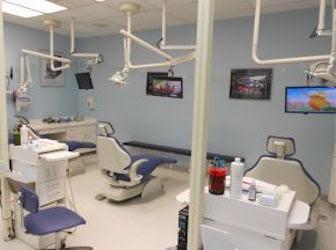


We at West Maple Pediatric Dentistry are focused and committed to providing optimal dental care in a friendly, caring and family oriented atmosphere. Our goal is to educate our patients, parents and community in preventative dental health care and in Healthy Ways of Living. Our ambition is to promote a lifetime of the richest health for you and yours.

Dr. Lourdes Secola has lived in Omaha for almost 25 years. She opened her practice April 12th, 1995 at West Maple Pediatric Dentistry on 142nd and Maple in Omaha. Dr. Lourdes Secola says, My reward is a job well done, aclose relationship with my patients and their families and service to my community at large to the best of my abilities.

I attended Central University of Venezuela and graduated with honors as an odontologa (i.e. Doctor in Dental Medicine); completed studies at Boston University with both a Masters of Dental Science in Pediatric Dentistry and with a Certificate in Advanced Studies in Pedodontics (Pediatric dentistry). After 7 years at the University of Florida as a part-time adjunct assistant professor in Dental Education and part-time in private practice, I moved to Omaha and completed an advanced standing two-year program at Creighton University School of Dentistry which allowed me to obtain my license and practice dentistry in the State of Nebraska. I was a part-time faculty member of Creighton University in Operative Dentistry at the Preclinical level for 9 years.
Currently, I am in private practice on full time basis. I have joined the clinical staff at the University of Nebraska Medical Center Pediatric Dentistry Residency Program and more recently the staff at Childrens Hospital and Medical Center.

Interceptive orthodontics is the guidance of teeth eruption and correction of malocclusion or abnormal bite, by early intervention in order to improve future outcome. This is usually achieved by simple or removable appliances.If your child loses any primary teeth as a result of trauma, decay or congenital reasons, your child may benefit from space maintainers. Space maintainers are appliances made of metal that are custom fit to your childs mouth. They are small and unobtrusive in appearance. Most children easily adjust to them after the first few days.

If a baby tooth is lost too soon, the teeth or tooth beside it may tilt or drift into the empty space. Teeth in the other jaw may move up or down to fill the gap. When adjacent teeth shift into the empty space, they create a lack of space in the jaw for the permanent teeth. Permanent teeth are crowded and come in crooked If left untreated. This condition may require extensive orthodontic treatment.
Space maintainers help to maintain the space previously occupied by the missing tooth and works to avoid further space loss. When your child reaches the appropriate age, the spacer will be removed so that the permanent teeth can erupt properly into the mouth. (Remember: Some baby teeth are not replaced until a child is 12 or 14 years of age.)
Its never too early to keep an eye on your childs oral development. Our doctor can identify malocclusioncrowded/crooked teeth or bite problemsand actively intervene to guide the teeth as they emerge in the mouth. Early orthodontic treatment can prevent more extensive treatment later.
Different orthodontic appliances work in different ways to benefit your childs dental health. Some are fixed; others are removable. Our doctor will explain which appliance is best for your child, what the treatment can do, and how long it will take.
Sedation dentistry refers to the use of sedation during dental treatment. Sedation is most commonly used during extensive procedures, for patients with dental phobias or for patients who find it difficult to sit still or have a special need. Sedation medication is used to calm a patient and is administered orally based on the patients weight. Patients with dental phobia, low pain tolerance, major dental treatment, physical handicaps or strong gag reflexes may require sedation. Procedures like fillings, crowns, and extractions often require sedation especially for patients under the age of 5 but may vary.
Sedation is endorsed by the American Dental Association and is an effective way to make many patients comfortable during their dental visit. Before using a sedative, it is important to tell your pediatric dentist about any medications or medical treatments your child is receiving. Before administering any sedative, your pediatric dentist will talk to you about the process of sedation and pre- and post-sedation instructions.
West Maple Pediatric Dentistry strives to go the extra mile in providing a service to your child. In return, we simply ask for your cooperation with the following rules to ensure only the best service for your children.