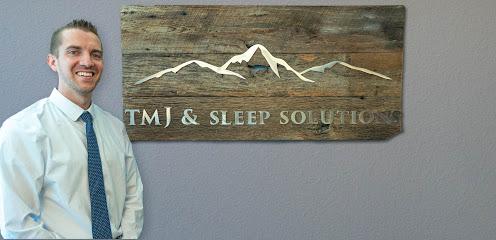


Dr. Edwards received his Bachelors of Science degree at the University of Nebraska Wesleyan in 2010 and completed his Doctorate at Creighton University School of Dentistry in 2015. After continuing his education and honing his expertise, Dr. Edwards left general dentistry completely to focus on the treatment of TMJ Dysfunction and Sleep Breathing Disorders.

Dr. Chase Edwards purchased TMJ & Sleep Solutions from Dr. Mark barnes in 2019, after working together with total continuity in treatment and ethical philosophies. Dr. Edwards continues to provide trusted quality care, he enjoys meeting our patients, is committed to serving, and believes in building long lasting relationships on the foundation of trust and respect.
Dr. Edwards grew up in the small town of Ogallala, NE. Him and his wife, Abby, have always dreamed of making their way to Colorado. Now, together with their two daughters, they call Colorado home. In their free time, you will find them hitting the slopes or waking in the crazy early morning hours to begin a long hike.
Certifications and Memberships Including: Creighton University School of Dentistry, Academy of General Dentistry, American Academy of Craniofacial Pain, American Dental Association, Colorado Dental Association, Colorado Mission of Mercy, 2017/2018,NCAA Pflieger/Olson Scholar Athlete.
We sleep about 1/3rd of our lives and science still cant find a reason why we do. Its such a fascinating cascade of chemistry, feedback loops and brain activity that still baffles science. There are still mysteries that our Creator uses to prove this stuff couldnt just evolve. Sleep is one of those mysteries.
If you wanted to have the ability to function at your best during the day, resist illness better, be mentally strong, how many hours do you have to sleep? This was the question asked by the senior study investigator Girardin Jean-Louis, a professor in the Department of Population Health and sleep research. The articles suggest 7-10 hours is optimal. There is a lot of research showing that less than 5 hours of sleep per night increases our risks for stroke, heart attacks, diabetes, high blood pressure, and fatal car accidents or work accidents.
Other symptoms that can develop with chronic sleep deprivation include; a weakened immune system, weight gain, a lack of libido, mood swings, paranoia, depression and a higher risk of dementia and some cancers.

Falling asleep instantly anywhere, anytime, is a sign that you are not getting enough sleep and youre falling into micro sleeps or mini-sleep episodes. It suggests your body is so exhausted that whenever it has a moment, its going to start to repay its sleep debt.
You feel sleepy because of a buildup of a chemical called adenosine in the brain, which happens throughout the day. Sleeping soundly reduces that chemical (in some of the sleep stages that are disturbed in Sleep Apnea) so that when you wake up, the levels are at their lowest, and you feel refreshed. The longer you stay up at night, the less sleep you get and adenosine levels rise, creating whats called a sleep debt.
People also believed that the brain and body could adapt and learn to function optimally with less sleep. That too is a myth, experts say. Thats because your body cycles throughfour distinct phases of sleepto fully restore itself.
Stage one is a light sleep and you are awakened easily. Your brain begins to send signals to disengage you from awaking in stage two, where you will spend most of your total sleep time. Stages three and four contain the deepest, most restorative sleep and the dreamy state of REM, or rapid eye movement sleep. Sleep Apnea and other medical conditions can prevent you from getting into REM (dream sleep) sleep.

REM can occur any time during the sleep cycle, but on average, it starts about 90 minutes after youve fallen asleep. REM is when your body and brain are busy storing memories, regulating mood and learning. Its also when you dream. Your muscles are temporarily paralyzed during REM sleep except for the heart, diaphragm, mouth, and ears, so you cant act out your dreams and can be awoken if danger approaches.
Some people have night terrors a sudden awaking where you feel paralyzed and unable to speak or move for a moment; this sudden waking from REM sleep is the reason. It takes a second or so for the brain to secrete the chemicals that re-connect the brain to the spinal cord and get signals to the motor muscles of the body.
Stage 3 sleep, or deep sleep, our brain waves slow into what is called delta waves or slow-wave sleep. Its the time when human growth hormone is released and memories are further processed. The deeper stages of sleep are really important for generation of neurons, repairing muscle and restoring the immune system, the author states.
In your dreams, maybe. In fact, loud, raucous snores interrupted by pauses in breathing is a marker for sleep apnea, a dangerous sleep disorder that, according to theNational Heart, Lung and Blood Institute, increases risk for heart attacks, atrial fibrillation, asthma, high blood pressure, glaucoma, cancer, diabetes, kidney disease and cognitive and behavior disorders.
Children can have sleep apnea from allergies, enlarged tonsils or adenoids or imbalanced jaw growth that is a side effect of mouth breathing. If a child snores even one night per week, is hard to get them asleep or very hard to wake them in the morning, that is possibly a sign of sleep apnea. In children, it will affect the brain development and growth of the face, bite, and TMJ.

Alcohol may help you fall asleep, but thats where the benefits end, the author states. Instead, it traps you in the lighter stages of sleep and dramatically reduces the quality of your rest at night. Metabolism of the alcohol continues to pull you out of rapid eye movement and the deeper stages of sleep where you get the feeling of a good nights sleep.

In reality, Robbins said, it takes a healthy sleeper about 15 minutes to fall asleep. If youre tossing and turning much longer than that, you should get out of bed, change the environment and do something mindless: Keep the lights low and fold socks, she suggested.
We recommend that people have a regular sleep schedule because it controls what we call the biological clock, or circadian rhythm, of the body, Jean-Louis said. That controls all the hormones of the body, body temperature, eating and digestion, and sleep-wake cycles.
When your inner clock and the outside world are out of phase, you can feel disoriented, mentally foggy and sleepy at times when you need to be functioning at optimal levels. Just think of what happens when you travel across time zones or when daylight savings time kicks in.
Studies of shift workers, who work unusual hours and live out of sync with their normal biological rhythm, show that they are at increased risk for heart disease, ulcers, depression, obesity and certain cancers, as well as a higher rate of workplace accidents and injuries due to a slower reaction rate and poor decision-making.
According to theNational Sleep Foundation, blue light affects the release of melatonin, the sleep hormone, more than any other wavelength of light. Watching TV or using an electronic device within two hours of bedtime means it will take you longer to fall asleep, youll have less dream state or REM sleep, and even if you do sleep eight or more hours, youll wake feeling groggy.
If you or your children cant make that two-hour cutoff because of homework or late-night work demands, experts suggest dimming the brightness of the screen or installing an app that can warm the screen to the sunset colors. Red and yellow have higher wavelengths and dont affect melatonin.
As you near the end of your sleep, your body is probably nearing the end of its last REM cycle. Hit that snooze button, and the brain falls right back into a new REM cycle. Now, when the alarm goes off a few minutes later, youll be in the middle, not the end, of that cycle, and youll wake up groggy and stay that way longer.
Thats a myth, because all of us do experience dreams four to five times a night, IF we are sleeping properly and going thought the full range of sleep stages Jean-Louis said. And we dont remember because weve not woken up and disrupted our sleep.

Astudy out of Franceshowed that people who frequently remember their dreams have higher brain activity in the information-processing hub of the brains. They also woke twice as often during the night and were more sensitive to sounds when sleeping and awake. This heightened awakens could be suggestive of obstructive sleep apnea or a Sleep Disorder typical of middle aged women called Upper Airway Resistance Syndrome. The airway becomes hyper-sensitive to narrowing in deeper sleep and will trigger a subtle awaking throughout the night, often associated with clenching/grinding of your teeth. This repeated TMJ loading is frequently one of the triggers for TMJ disorders.
Now, I will tell you if you have a dream with a strong emotional context, it may come back to you at say, two oclock in the afternoon, when you have some downtime to relax, Jean-Louis said. Sometimes, something would trigger that. But if it is a weird little mundane dream, most of us who sleep well dont remember those.
The research team found more myths that we tend to accept as fact, Jean-Louis said, such as more sleep is always better (no, you really can sleep too much and harm your health), taking a nap in the afternoon can fix insomnia (actually, if you sleep long enough to enter a REM or deep sleep cycle, it can mess up your body clock even more), and its better to have a warm than cool bedroom (no, you sleep better in cooler temps).
Which means that we could all use a bit of education about good sleep hygiene, a set of habits to form that will set you up for a lifetime of healthy sleep. TheNational Sleep Foundation has tips, as does our website at WWW. TMJSLEEPSOLUTIONS.COM.