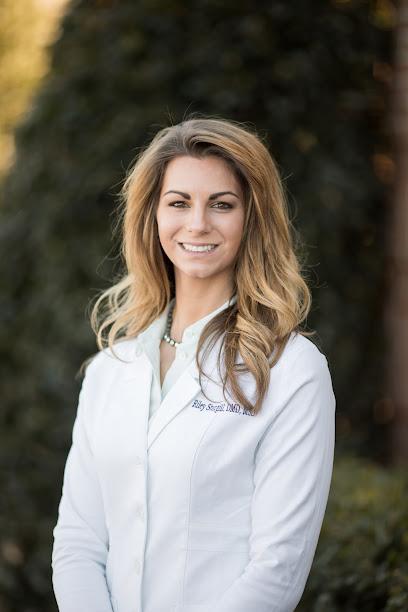


Callie joined the practice in November 2018 and is one of our teams friendly dental assistants. Her warm smile and pleasant demeanor put even the most apprehensive patients at ease. Her passion and knowledge for Endodontics makes her an excellent resource, and she enjoys the opportunity to educate our patients. Callie resides in Greeneville, TN. When she isnt assisting, Callie enjoys time with her fianc Zane, family, and friends.
Who is your hero?My hero is my Dad. From the time I was a little girl, all the way to playing college softball, my dad has been my coach. On the softball field and off. He has coached me through the hardest collegiate games and hardest times life has thrown at me.
What are your hobbies?My hobbies include going to church with my big family, mediocre baking, photoshoots with my dog, Nellie, and watching The Bachelor/Bachelorette with my best-friends on Monday nights.
Dr. Riley Sturgill is a native of Piney Flats, Tennessee. She received her Bachelor of Science in Cell and Molecular Biology from King College in 2008, where she met her husband, Jeremiah, who provides orthodontic care to the tri-cities. Following college, she earned her Doctor of Dental Medicine from A.T. Still University at the Arizona School of Dentistry & Oral Health in 2013.
After graduation from dental school, Dr. Sturgill practiced general dentistry in Phoenix, Arizona before moving to Richmond, Virginia to complete an endodontic residency program at Virginia Commonwealth University. In 2017 she earned her Certificate in Endodontics and Master of Science in Dentistry. Shortly thereafter, Dr. Sturgill opened Sturgill Endodontics, a private practice limited to endodontics and microsurgery.
Dr. Sturgill is committed to staying at the forefront of endodontic knowledge and attends numerous continuing dental education courses and has completed research projects that have been presented at national meetings. She is a member of the American Dental Association, the Tennessee Dental Association, the First District Dental Society, the American Association of Endodontists, the American Association of Endodontists Foundation for Endodontics, and is currently pursuing diplomate status with the American Board of Endodontics.Dr. Sturgill also teaches the residents of the VCU Endodontic Residency Program, which gives her an edge in staying up-to-date with the latest dental literature and clinical knowledge.
Recognized by theAmerican Dental Association, endodontics is a specialized branch of dentistry focused on the treatment of the pulp and surrounding tissues of a tooth. The visible part of your tooth is the crown, and the portion hidden beneath the gum line is the root. The roots hard outer tissue is called cementum, and the inside channel, or root canal, contains your tooths pulp, a soft tissue composed of blood vessels and nerves. When tooth decay, periodontal disease or a fracture introduce bacteria into the pulp, discomfort and severe damage ensue.
At Sturgill Endodontics, we treat root canals and provide full service endodontic treatments to save the tooth and prevent further problems and discomfort. After successful therapy, your general dentist will restore the tooth to normal function.
Endodontics is a specialty of Dentistry that deals with diseases of the dental pulp and its supporting structures. Endodontists are Dentists with special post-graduate training in this field. Endodontists are also experienced at finding the cause of oral and facial pain that has been difficult to diagnose.
In order to understand endodontic treatment, it helps to know something about the anatomy of a tooth. Teeth have several layers. The outside layer of the tooth is composed of a hard layer called Enamel. Enamel is supported by an inner layer called Dentin, which has at its center a soft tissue known as the Pulp.
The pulp contains blood vessels, nerves, and connective tissue that are responsible for forming the surrounding Dentin and Enamel during tooth development. The pulp receives its nourishment supply from vessels which enter the end of the root. Although the pulp is important during development of the tooth, it is not necessary for function of the tooth. The tooth continues to be nourished by the tissues surrounding it even after the pulp is removed.


At Sturgill Endodontics, Dr. Sturgill is in network with several insurance providers. Please call to inquire if your insurance plan is accepted at our office. Even if your plan is out-of-network, we are always happy to file a claim to your insurance provider for you. Even out-of-network plans may cover a substantial portion of root canal treatment in some cases. We will always work with you to determine your estimated cost for treatment so you can be prepared.
Toothache pain is the main reason for patients seeking treatment. Fortunately, modern anesthetics can make the procedure pain free in most cases. Seeking treatment early makes the procedure more comfortable, so dont wait. When caught early, treatment should feel no different than having a regular filling. For the first few days after treatment, there may be some sensitivity to biting pressure, especially if there was pain or infection before the procedure. Sometimes over-the-counter anti-inflammatory medications (like Advil) are recommended for a day or two. Dr. Sturgill can prescribe other medications but they are rarely required.
Infection Occasionally bacteria will persist in or around your tooth following root canal treatment. Please notify your endodontist if you notice any signs of swelling, fever, drainage of pus or pain. Antibiotics are sometimes indicated in these situations. Also, sometimes an additional therapy will improve the chances of a successful outcome. Such therapies include re-treatment of the root canal and apical surgery.
Breaking or fracture of a tooth This usually occurs following a root canal treatment if the tooth is not restored properly within a timely manner. A crown is typically indicated to protect your tooth after a root canal. Think about the rings around a barrel holding the wood pieces together. Your tooth is not protected without a permanent restoration placed by your general dentist or a prosthodontist.
Root fracture This is not common at all, but can result from having multiple root canals done on a tooth, or from the stress of having root canal treatment. Apical surgery or extraction is usually necessary to alleviate pain and infection that occur after a root fractures.
Numbness Also known as paresthesia this is extremely rare and is most common after apical surgery is performed. The good news is that it usually resolves over a period of weeks to months. Definitely keep your endodontist updated if you experience any numbness following treatment.