

Dr. Michael Graffeo received his DDS from New York University School of Dentistry. He then completed his Residency Program in Oral and Maxillofacial Surgery at Lincoln Hospital (Weill Medical College of Cornell University). Dr. Graffeo completed his final year as a Chief Resident of the Oral & Maxillofacial Surgery program.
Dr. Graffeo received extensive training in implantology, bone grafting, dentoalveolar surgery, and facial reconstructive. His interests also include facial trauma, pathology and the treatment of full mouth reconstruction.
Dr. Graffeo has lectured on various topics including full scope Oral and Maxillofacial Surgery with a concentration in reconstruction, dental implantology, bone grafting and noninvasive cosmetic surgery.
Dr. Graffeo is a Board Certified Oral and Maxillofacial Surgeon. He is a member, fellow, and Diplomate of the American Board of Oral and Maxillofacial Surgeons. He additionally is a member of the American Association of Oral and Maxillofacial Surgeons, New York Society of Oral and Maxillofacial Surgeons, American Dental Association, New York State Dental Association, and the Ninth District Dental Association.

Dr. Harrison Linsky received his DDS from Columbia University School of Dental & Oral Surgery and received his Medical Degree from The Mount Sinai School of Medicine. He then completed the Residency Program in Oral and Maxillofacial Surgery at The Mount Sinai Hospital in New York, NY. While at Mount Sinai, Dr. Linsky completed a one-year internship in general surgery, and his six-year specialty training in Oral & Maxillofacial surgery.
Dr. Linsky is a Board Certified Oral and Maxillofacial Surgeon. He is a member, fellow, and Diplomate of the American Board of Oral and Maxillofacial Surgeons. Additionally, he is a member of the American Association of Oral and Maxillofacial Surgeons, New York Society of Oral and Maxillofacial Surgeons, American Dental Association, New York State Dental Association, and the Ninth District Dental Association. He maintains clinical and teaching privileges at Mount Sinai Hospital in New York, NY.
The person who has lost teeth regains the ability to eat virtually anything, knowing that teeth appear natural and that facial contours will be preserved. Patients with dental implants can smile with confidence.
For most patients, the placement of dental implants involves two surgical procedures. First, implants are placed within your jawbone. For the first three to six months following surgery, the implants are beneath the surface of the gums gradually bonding with the jawbone. You should be able to wear temporary dentures and eat a soft diet during this time. At the same time, your dentist is forming new replacement teeth.
After the implant has bonded to the jawbone, the second phase begins. Dr. Graffeo or Dr. Linsky will uncover the implants and attach small posts that protrude through the gums and will act as anchors for the artificial teeth. When the artificial teeth are placed, these posts will not be seen. The entire procedure usually takes six to eight months. Most patients experience minimal disruption in their daily life.
Dental Implant placement is a team effort between an oral and maxillofacial surgeon and a restorative dentist. While Dr. Graffeo and Dr. Linsky perform the actual implant surgery, initial tooth extractions, and bone grafting if necessary, the restorative dentist (your dentist) fits and makes the permanent prosthesis. Your dentist will also make any temporary prosthesis needed during the implant process.
A single prosthesis (crown) is used to replace one missing tooth each prosthetic tooth attaches to its own implant. A partial prosthesis (fixed bridge) can replace two or more teeth and may require only two or three implants. A complete dental prosthesis (fixed bridge) replaces all the teeth in your upper or lower jaw. The number of implants varies depending upon which type of complete prosthesis (removable or fixed) is recommended. A removable prosthesis (over denture) attaches to a bar or male- female attachments, whereas a fixed prosthesis is permanent and removable only by the dentist.
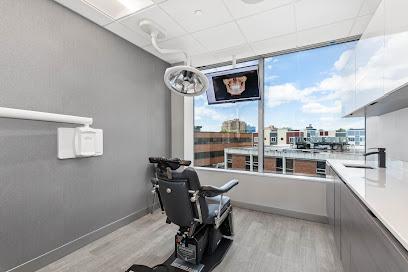
Dr. Graffeo and Dr. Linsky perform in-office implant surgery in a hospital-style operating suite, thus optimizing the level of sterility. Inpatient hospital implant surgery is for patients who have special medical or anesthetic needs or for those who need extensive bone grafting from the jaw, hip or tibia.
Once you learn about dental implants, you finally realize there is a way to improve your life. When you lose several teeth whether its a new situation or something you have lived with for years chances are you have never become fully accustomed to losing such a vital part of yourself.
A Swedish scientist and orthopedic surgeon, Dr. Per-Ingvar Branemark, developed this concept for oral rehabilitation more than 35 years ago. With his pioneering research, Dr. Branemark opened the door to a lifetime of renewed comfort and self-confidence for millions of individuals facing the frustration and embarrassment of tooth loss.
There are several reasons: Why sacrifice the structure of surrounding good teeth to bridge a space? In addition, removing a denture or a partial at night may be inconvenient, not to mention that dentures that slip can be uncomfortable and rather embarrassing.
If you are considering implants, your mouth must be examined thoroughly and your medical and dental history reviewed. If your mouth is not ideal for implants, ways of improving outcome, such as bone grafting, may be recommended.
With bone grafting, we now have the opportunity to not only replace bone where it is missing, but also the ability to promote new bone growth in that location! This not only gives us the opportunity to place implants of proper length and width, it also gives us a chance to restore functionality and aesthetic appearance.
Autogenous bone grafts, also known as autografts, are made from your own bone, taken from somewhere else in the body. The bone is typically harvested from the chin, jaw, lower leg bone, hip, or the skull. Autogenous bone grafts are advantageous in that the graft material is live bone, meaning it contains living cellular elements that enhance bone growth.
However, one downside to the autograft is that it requires a second procedure to harvest bone from elsewhere in the body. Depending on your condition, a second procedure may not be in your best interest.
Allogeneic bone, or allograft, is dead bone harvested from a cadaver, then processed using a freeze-dry method to extract the water via a vacuum. Unlike autogenous bone, allogeneic bone cannot produce new bone on its own. Rather, it serves as a framework or scaffold over which bone from the surrounding bony walls can grow to fill the defect or void.
Xenogeneic bone is derived from non-living bone of another species, usually a cow. The bone is processed at very high temperatures to avoid the potential for immune rejection and contamination. Like allogeneic grafts, xenogeneic grafts serve as a framework for bone from the surrounding area to grow and fill the void.
Both allogeneic and xenogeneic bone grafting are advantageous in that they do not require a second procedure to harvest your own bone, as with autografts. However, because these options lack autografts bone-forming properties, bone regeneration may take longer than with autografts, with a less predictable outcome.
This product is processed allograft bone, containing collagen, proteins, and growth factors that are extracted from the allograft bone. It is available in the form of powder, putty, chips, or as a gel that can be injected through a syringe.
Graft composites consist of other bone graft materials and growth factors to achieve the benefits of a variety of substances. Some combinations may include: collagen/ceramic composite, which closely resembles the composition of natural bone, DBM combined with bone marrow cells, which aid in the growth of new bone, or a collagen/ceramic/autograft composite.
Synthetic materials also have the advantage of not requiring a second procedure to harvest bone, reducing risk and pain. Each bone grafting option has its own risks and benefits. Drs. Graffeo and Linsky will determine which type of bone graft material is right for you.