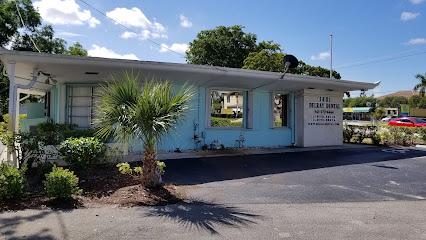


We pride ourselves on handling DENTAL EMERGENCIES during regular office hours! As brothers and partners in practice, one of us is always local to cover the unforeseen emergency needs of our clientele!
We come from a family with an extensive history of treating patients. Over 150 years of combined service experience. In January 2007, our father retired from practicing general dentistry in South Orange, New Jersey after59 years. His brother (our uncle) practiced cardiology for 55 years in NJ and all three of his sons are practicing physicians.
We can both surgically place and cosmetically restore your dental implants in one convenient location, avoiding the need to travel from office to office. We are always willing to provide a second opinion for FREE!

Dr. John Ritota graduated from Ithaca College and Georgetown University School of Dentistry. He is a member of the South Palm Beach County Dental Assn., The New Jersey Dental Assn., The American Dental Assn., and The Florida Academy of Dental Practice Administration. Dr. John has additional training in IMZ, Stryker, ITI Dental Implant System and completion of the Alabama Implant Congress. His abstract Observation of thee Auriculotemporal Nerve in Human Specimens was presented to the American Academy of Oralfacial pain Scientific Congress on temporal mandibular disorders. Dr. John has been published in the Outstanding Young Men In America as a recipient of the Van Cliburn Award and for extensive TMJ Dental Research. Dr. John Ritota is licensed to practice general dentistry in Washington D.C., New Jersey, and Florida.
Dr. Theodore Ritota graduated from the University of Colorado, Phi Beta Kappa, and the Fairleigh Dickinson University School of Dentistry. He is a member of the South Palm Beach County Dental Assn., The New Jersey Dental Assn., The American Dental Assn., and a past member of The Florida Academy of Dental Practice Administration. Dr. Ted is also the president of the Aesculapian Society since 1991, a continuing education consortium of all health care professionals. Dr. Ted has completed advanced training in ALL MAJOR implant systems including, BRANNEMARK, STRAUMANN (ITI), ZIMMER, INTRA-LOCK, and MIS. Dr. Ted has also completed numerous, 9 month, year long, and several 2 year long surgical residencies for the placement of implants and actively seeks continuing education in the field of IMPLANT DENTISTRY. Dr. Ted is licensed to practice general dentistry in Florida, New Jersey and Colorado. In Sept. 2008 he completed a 16 hour FBI training for Forensic Dental Coding.
As of April 2016 Dr. Ted was honored to be hired by Canadian Mountain Holidays (CMH) as their Southeastern North America representative. CMH is an eclectic travel company that specializes in Heliskiing and Helihiking in some spectacular terrain of British Columbia, Canada. Heliskiing has been a passion of Dr. Teds for over 30 years!
Any socket in which a patient is having pain due to the loss of the blood clot thus exposing the bone to air, food, and fluids along with an offensive odor. This often occurs two or more days after an extraction and can last about 5-6 days. It is normal to have soreness and discomfort following an extraction. However, pain should be lessening by the second day.
This condition exist when a blood clot is dislodged from the surgery site thus exposing the bone and fine nerve endings. The blood clot helps in the stopping of bleeding and lays the foundation or framework for new tissue and bone to develop over a two-month healing process. This condition is more common in the mandibular area and in back teeth due to poorer circulation in this area, with wisdom teeth being the most common site. Dry socket delays the healing process.
We have experienced fewer cases of dry socket since every patient is asked to rinse with an antimicrobial mouthwash and each patient is instructed on how to care for their extraction site through our patient education, verbal instruction and home care instruction handouts. We highly recommend patients use Peridex their daily oral hygiene routine to help control oral bacterial
That tests on 267 women showed that those on the birth control pill were more susceptible than non-users to both postoperative pain and a condition known as dry socket. In this condition, normal healing of the vacant tooth socket is delayed by the failure of a blood clot to form. Infection instead causes the socket to remain empty. In the study, pain on the day after the operation was experienced by 30 percent of pill takers compared to just 11 percent of non-users. Five days after the operation the difference was 14 percent compared to 5 percent. The researchers said these results suggest that the pill may reduce the pain threshold. The differential was similar when the development of dry socket was compared. Here, 11 percent of pill users were affected compared to 4 percent of non-pill users.