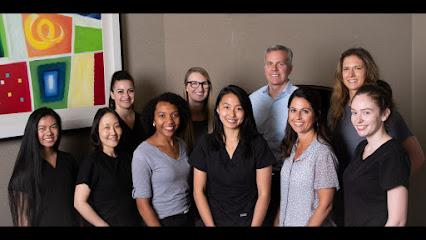


Dr. Nelson was raised in Seattle and attended University Prep, Roosevelt, and Shorewood High School. He spent his high school summers working in his fathers orthodontic lab where he began to develop an interest in orthodontics.
Dr. Nelson received his B.A. in Economics from Brigham Young University and his DDS from the University of Washington. Following dental school, he completed a General Practice Residency at the V.A. Hospital in Salt Lake City, Utah. He then completed graduate studies in orthodontics at the University of Washington where he received his orthodontic certificate and Master's degree and published research in the American Journal of Orthodontics.
Outside of work, Paul can be found spending time with his wife and four sons and their many activities. He has coached several teams and has been extensively involved with mentoring youth groups. He enjoys reading, basketball, and other outdoor sports. He also likes following the local high school sports scene. He currently serves as president of the University of Washington Orthodontic Alumni Association.

Your smile is often the first thing that people notice, it is an announcement to the world. It is also a window to an essential part of your oral health the alignment of your teeth. Unfortunately, not everyone is born with naturally well-aligned teeth.
People pursue orthodontic treatment for many reasons. For many, correcting functional bite issues can lead to improved oral health. Benefits of well-aligned teeth include more evenly distributed wear of teeth and an improved ability to access tooth surfaces for adequate cleaning. Others are primarily interested in an aesthetic correction to improve appearance. Orthodontics is both an art and science and form follows function. Typically, the correction of underlying bite and tooth alignment issues results in a great-looking smile -- a win/win!
Your Seattle Orthodontist, Dr. Nelson, will listen to your concerns and objectives and make it our mission to address them completely. Whether you are interested in a tune-up of the lower front teeth or a comprehensive correction of your bite, our objective is to explain your options clearly and then exceed your expectations by creating a healthy, radiant smile for life.
Orthodontics is a specialized field of dentistry that addresses teeth and jaws that are incorrectly positioned. Crooked teeth and teeth that do not fit together correctly are more difficult to keep clean which may lead to tooth decay and periodontal disease. A misaligned bite or crooked teeth may cause extra stress on the muscles used for chewing and may lead to headaches and TMJ. Misaligned teeth can also detract from one's appearance.
Every patient is unique. The best time to begin treatment is knowing when upon completion will be the most efficient and give the best permanent results. For some patients, this may mean initiating treatment before all of the permanent teeth have erupted (interceptive treatment). For other patients, it is best to wait until all the permanent teeth have come in to begin treatment. The American Association of Orthodontists recommends an initial orthodontic evaluation by age seven. By completing an assessment at this age, a determination can be made about optimal treatment timing.
Early evaluation allows timely detection of orthodontic problems for more efficient treatment. Timely intervention guides growth and development, which may prevent serious problems later. If orthodontic problems are diagnosed but treatment would be more adequately addressed at a later date, we will carefully monitor growth and development so that treatment recommendations can be made at the appropriate time.
By age seven, the first molars and front incisors are usually coming in, giving valuable information regarding the front to back and side to side relationships of the teeth. At this age, information regarding crowding and bite relationships (overbites and underbites) can be assessed.
The result of orthodontic treatment is an attractive smile with teeth in proper alignment. While the aesthetic benefit of treatment is evident, the functional benefits of correcting a poor fitting bite (malocclusion) are equally important even if less apparent. Malocclusions occur as a result of tooth or jaw misalignment. Having teeth in an ideal alignment will improve your ability to clean your teeth and also improve the way the teeth wear over time.
According to studies by the American Association of Orthodontists, untreated malocclusions can result in a variety of problems. Crowded teeth are more difficult to brush properly and floss, which may contribute to tooth decay and gum disease. Protruding teeth are more susceptible to accidental chipping. Crossbites can result in unfavorable growth and uneven tooth wear. Openbites can result in tongue-thrusting habits and speech impediments. Ultimately, orthodontics does more than make a pretty smileit creates a healthier you.
Braces arent just for kids anymore. Options such as clear aligners and translucent, ceramic braces have caused a dramatic increase in the number of adults who are pursuing orthodontic treatment. Tooth alignment can be changed at any age, and many of our patients are adults.
Orthodontic treatment as an adult can dramatically improve your appearance and self-esteem. Improving the health of your teeth and gums is equally important. Crooked teeth and a bad bite can contribute to gum and bone loss, tooth decay, and abnormal wear of tooth enamel.
The advantages of orthodontic treatment include a healthier mouth, improved appearance, and teeth that are more likely to last a lifetime. By creating a better bite, orthodontic treatment may decrease the risk of future and potentially costly dental problems. A malocclusion (poor bite) can cause:
The American Association of Orthodontists recommends an orthodontic screening at age 7. By this age, several permanent teeth in most children have erupted, allowing us to effectively evaluate your orthodontic condition.
Upon arriving, each patient will be asked for the new patient forms and insurance card. The doctor will then complete a thorough clinical exam. Additional information, such as X-rays or photographs, may be needed for proper diagnosis.
Removing teeth is sometimes required to achieve the best orthodontic result. Straight teeth and a balanced facial profile are the goals of orthodontics. While extractions are sometimes recommended to meet these objectives, the vast majority of patients are treated without needing teeth removed.
Treatment time obviously depends on each patients specific orthodontic problem. In general, treatment lasts from 8 to 30 months. The average duration of orthodontic treatment is approximately 18-24 months.
It is impossible to give an exact cost for treatment until we have examined you. We will cover the exact cost and financial options during the initial examination. We have several financing options available to accommodate your needs, and we will review these with you. We will also review your insurance policy and help to maximize your benefit and file your claims.
Yes. We understand your busy schedule, and we are happy to help you make the most of your time. On some occasions, we may request to speak with a parent when they return, so we ask that parents check in with their patient manager before dropping off their child.
Generally, braces do not hurt. After certain visits, teeth may be sore for a few days. In these situations, pain medications such as Advil or Tylenol will ease the discomfort. However, after most visits, patients do not feel any soreness at all! We often remind our patients, It does not have to hurt to work!
Patients should brush their teeth, at least, four times each day - after each meal and before going to bed. We will show each patient how to floss their teeth with braces and may also provide a prescription for a special fluoride, if necessary.
Yes. Some orthodontic problems are significant enough to require early intervention. However, if a patient is not yet ready for treatment, we will follow that patient's growth and development until the time is right for treatment to begin.
Phase One treatment, if necessary, is usually initiated for children between the ages of 7 and 10. Phase One treatment usually lasts about 6-18 months. The primary objective for Phase One treatment is to address significant problems to prevent them from becoming more severe and to improve self-esteem and self-image.
It is best to assume that your child will need full braces even after Phase One treatment. The period following Phase One treatment is called the 'resting period,' during which growth and tooth eruption are closely monitored. Throughout this period, parents and patients will be kept informed of future treatment recommendations.
A surprising percentage of our patients are adults. In fact, 25 percent of all orthodontic patients are adults. Health, happiness, and self-esteem are vitally important to adults. No patient is 'too old' to wear braces!
Teeth, and sometimes entire facial structures, are permanently changed by orthodontic treatment. It is important that the treatment is appropriate and properly completed. Orthodontic specialists have extensive and specialized training that enables them to provide their patients with professional, personalized treatments.