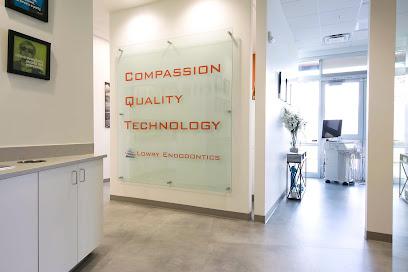


Dr. Rahim Karmali created Lowry Endodontics to offer you world-class care. His compassionate approach to diagnosing and treating oral pain has earned him global recognition amongst leaders in the field.
Dr. Karmali is sought after by patients for his conservative and innovative approach to managing pain. His practice is focused on understanding before treating. It is focused on trying conservative approaches before aggressive ones. He has gained the reputation of predictably saving teeth that would otherwise require extraction.
Dr. Karmali was raised in Seattle. He attended the University of Washington to earn a Bachelors in Science in Zoology and a Doctorate of Dental Surgery. Upon graduation, he served with the United States Navy as a Dental Officer. He was stationed around the globe with the Navy and the Marines. After completing his service, he returned to the Long Beach Veterans Administration Medical Center to specialize in Endodontics
Dr. Karmali pursues the highest standards in clinical excellence through constant education. He is the Past President of the International Academy of Endodontics. He lectures internationally on conservative diagnosis and treatment. He is the leader of a nationally recognized study club. Dr. Karmali's passion for professional and personal growth is focused on helping his patients maintain their natural dentition for a lifetime.
We have the latest in low radiation 3D imaging which improves our ability to diagnose and conservatively treat your problem. After the 3D scan, Dr. Karmali will take the time to explain the findings and discuss your treatment options in detail.
We also utilize the most powerful dental microscope in the world. This provides us with unsurpassed magnification and illumination. This enables us to deliver the best care possible. We are also able to capture high-quality digital images during the procedure. This allows us to communicate with you and your referring dentist in ways that were previously unimaginable.
We use the latest in digital radiography. What this means to you is that we can reduce your exposure from x-rays by about 90%. Since these images are all digital, there are no processing chemicals used and your time spent during treatment is greatly reduced.
Dr. Karmali and his Lowry Endodontics staff regularly attend continuing education courses to keep abreast of the changes in medicine, dentistry, and endodontics. We feel that our patients deserve the very best from us, so we strive to continually improve.
In medicine, there are numerous different specialties that manage your overall health. You typically work with your Primary Care Provider. If you have a complex issue, you often get referred to a specialist.
Dentistry is no different. You see your General Dentist most often. If they notice a problem that requires more advanced care, they may refer you to a specialist. The different specialties can be confusing. We have created this guide on endodontist vs dentist to help you.
An Endodontist is a dentist whose main focus is root canal treatments. Endodontists have years of additional specialty training and equipment. With their primary focus on doing root canal treatments, they often have a vast amount of experience in that procedure.
The focus of your General Dentist is to ensure your overall oral health. They do frequent oral exams to detect oral cancer, cavities, and gum disease. They are the experts in restoring or replacing teeth. They help you maintain a healthy mouth with preventive care. They can also give you a beautiful smile with the latest techniques in esthetics.
The focus of your Endodontist is on managing pain and infection coming from the inside of the tooth. Your General Dentist might suspect an infection if you complain of pain and swelling. Sometimes, you can have a serious infection and not have any signs or symptoms at all. Your General Dentist just might notice a potential abscess on an x-ray. Regular x-rays from your General Dentist are very important in detecting these silent infections.
Both endodontists and dentists go to dental school after obtaining their undergraduate degrees. After dental school, General Dentists often move directly into practice. An Endodontist is a General Dentist who continues their training for an additional 2-3 years. This often occurs after the General Dentist has acquired several years of clinical experience and returns to a residency. The focus of their specialized training is on managing tooth pain and infections. The endodontists main role is performing root canal treatments. The extra training and experience make Endodontists uniquely qualified for this complex procedure.
Endodontists have access to the latest technology. These specialists perform many more root canals than the average dentist, so they can invest in the latest equipment designed to improve outcomes. Lowry Endodontics is one of the most technologically advanced practices in the country.
We have the worlds most powerful dental operating microscope. It allows us to see and treat things that can often be missed. The main reason Dr. Karmali has to retreat root canals done elsewhere is that canals or anatomy have been missed. The microscope also helps in managing calcified canals and cracked teeth.
Lowry Endodontics has a high-resolution CBCT. This special type of CT scan allows Dr. Karmali to evaluate your tooth 3 dimensionally and in very fine detail. This helps in determining the cause and extent of your problem. It leads to more accurate diagnoses and more conservative treatment approaches.
Dr. Karmalis philosophy is to provide a treatment that is both successful and highly conservative. He was instrumental in developing the minimally invasive methods used today. He lectures internationally on providing this type of conservative care.
The process starts with determining if root canal treatment is even needed. If simpler treatment options are available, they should be explored. If root canal treatment is needed, it will be done in a way that retains the strength of the tooth while thoroughly managing the complex internal anatomy. After treatment, the tooth is then restored to maximize the remaining strength.
Dr. Karmali is constantly bolstering his knowledge and refining the latest endodontic treatment methods. He shares his experience openly by lecturing around the world on conservative endodontic diagnosis and treatment. He has served as the president of the International Academy of Endodontics. Through constant growth, Dr. Karmali utilizes the most innovative methods to help his patients see better outcomes and experience less pain.
If bacteria is left inside the tooth, or leaks into the tooth, an infection can persist. Endodontists have the equipment, experience, and training to reduce the risk of your treatment failing from a persisting infection. If you do have a persistent infection, the root canal treatment can often be done again to save your tooth. A large part of Dr. Karmalis practice centers around retreating teeth with previous root canals. Oftentimes, the infection persists because anatomy inside the tooth has been overlooked.
Patients who need root canal treatment or root canal retreatment can see an endodontist. A referral from your General Dentist is not always required. While a referral from your General Dentist is one way to see an Endodontist, patients can also refer themselves.
If you seek a second opinion, Lowry Endodontics welcomes you. Many teeth are recommended for extraction that can be predictably saved. With advanced equipment, much more is possible today than ever before.
Endodontists work hard to save your teeth. Root canal treatment is a highly complex procedure that requires a deft hand, expert techniques, and the latest technology to maximize the odds of a positive outcome.
Root Canal Specialists can offer high-tech equipment and the latest techniques. Less pain and complications are often the end result. If you are concerned about pain during treatment, discuss your concerns with Dr. Karmali. Reducing your anxiety and keeping you comfortable during treatment is important and achievable. Compassionate quality care is what we stand for.
Root canal treatment is a common and painless procedure that can save your tooth. Several symptoms indicate that you have a problem with a tooth. Many times, you can have a serious infection and not have any outward symptoms. This is one of the things that make these infections so dangerous. So, when is a root canal needed?
Temperature sensitivity can be a common problem with teeth. Not all sensitive teeth require root canal treatment. If your temperature sensitivity is extreme, or if the pain lingers after the temperature is removed, then something more serious can be happening.
Never take tooth pain lightly, especially if the tooth pain persists. Pain could remain constant or ebb and flow. Sometimes, it completely resolves only to resurface in the future. Some people describe a deep pain in their jaw bone while others have referred to pain in nearby teeth or their face.
Swelling inside the mouth usually indicates an infection. It can mean that the infection has spread from the tooth to the jaw bone. This can have serious consequences. Just like with pain, the swelling may come and go. The swollen spot may feel tender or lack any pain.
Sometimes, you may feel no symptoms at all, but your dentist may notice an abscess on an x-ray during routine exams. An abscess is an area of infection that can occur if your tooth infection spreads to the jaw. If a dentist notices this sign of infection, you may get a referral to an endodontist for evaluation. Advanced 3D imaging can be done to determine the extent of the damage and to determine your best treatment alternatives.
Biting should not hurt. However, if you have problems with the interior of your tooth, you may feel pain when you bite down. Over time, you might even try to compensate by chewing on one side of your mouth. Bite sensitivity, though, is another sign that something is wrong. Oftentimes, a conservative bite adjustment might be all that is needed. Sometimes, bite tenderness can mean that an infection is forming. In those cases, careful root canal treatment can predictably resolve your pain.
Endodontists perform root canal treatments to prevent or resolve an infection. The purpose of root canal treatment is to save your tooth and preserve your jaw bone. Inside each tooth is soft tissue known as pulp. This pulp supplies the tooth with nerves, blood supply, and immune functions. However, if the pulp gets diseased, it can cause inflammation or infection.
Root canal treatment is a procedure that an endodontist performs to remove the diseased pulp from the tooth. This removes the source of the pain and infection that sent you to the dentist or endodontist in the first place. By removing the source of infection, the endodontist allows you to keep your natural tooth and can get your jaw to heal naturally. Getting out the infected matter also removes bacteria that could spread throughout your body if left unchecked.
When you visit the endodontist for a root canal treatment, you will have the area numbed and prepared for the procedure. Endodontists are experts in making sure that your treatment will be painless. The endodontist will make a small opening in the tooth and remove the pulp from the tiny canals in your roots. After removing the infected, dead, or inflamed pulp, the canals are thoroughly disinfected. The canals and the inside of the tooth are then sealed to prevent bacteria from entering.
In the hands of a skillful endodontist, you shouldnt feel any pain during a root canal treatment. Plus, there should only be mild levels of discomfort, if any, afterward. Endodontists are experts in preventing pain and ensuring that any discomfort you feel after the procedure is minimal. This pain management knowledge sets them apart from dentists who may not receive this additional training.
Some endodontists or dentists recommend root canal treatments too often. Dental pain does not always indicate a need for root canal therapy. It could be referred pain from another part of the mouth. Often, root canal-type pain could have many different causes that require alternative treatments to root canal therapy. Some types of pain can be very easily managed.
A thorough and accurate diagnosis is essential to planning the appropriate care. If you have been told that you need an extraction or you have had a root canal treatment that is failing, a second option from a skilled endodontist might be a good next step. Depending on the specifics of your case, you may have simpler, less expensive options available.