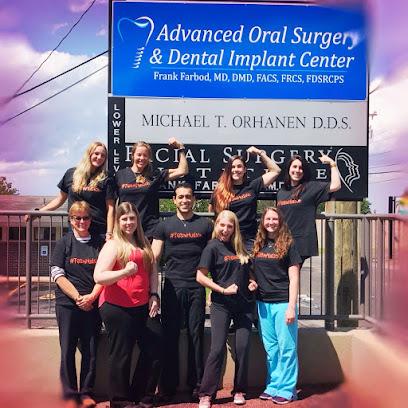


As the director, and founder of the Facial Surgery Institute, the first of its kind in the Upper Peninsula, Northern Michigan, and eastern Wisconsin , Dr. Farbod specializes in all aspects of facial and skull aesthetic plastic and reconstructive surgery. Dr. Farbod also specializes in cleft lip & palate, and oral & Maxillofacialsurgery.
Following graduation from Mountain Point High school in Phoenix, Arizona. Dr. Farbod completed his Bachelor of Science Degree (B.S.) at Northern Arizona University in medical microbiology with honors. He was then accepted to one of the top eight Ivy League schools in the world, the University of Pennsylvania, which was ranked second by US World News, where he received his Doctor of Dental Medicine (D.M.D) degree with honors and graduated at the top of his class. Dr. Farbod chose to pursue the artistic science of facial and cosmetic surgery in the old tradition, where specialization in facial surgery requires both a medical and dental degree to fully master the head and neck region. Dr. Farbod went on to complete his Medical Doctor degree (M.D.) at Wayne State University.
Dr. Farbod completed his Internship at the University of Pittsburgh Medical Center, his pediatric and adult anesthesia training at Childrens Hospital of Michigan, and Detroit Medical Center-Receiving Hospital, respectively. He completed his Oral & Maxillofacial surgery residency at St. John-Providence and William Beaumont hospitals where he received numerous awards and was chosen as the Chief Resident. He is one of only a handful Surgeons that have been accepted to complete a fellowship in Aesthetic Plastic surgery and Craniofacial & Cleft surgery under the tutelage of one of the founding fathers of modern plastic and craniofacial surgery,Dr. Ian T. JacksonMD, DSc, FRCS, FACS, FRACS at the Craniofacial institute/Providence Hospital, where he received the distinguished Golden Scalpel award.
Dr. Farbod is board certified by The American Board of Oral & Maxillofacial Surgery, and a member of the American Academy of Facial Plastic and Reconstructive Surgery, American College of Surgeons, American Academy of Cosmetic Surgery, North America Skull Base Society, American Cleft Palate Craniofacial Association the American Association of Oral and Maxillofacial Surgeons, and Chalmers J. Lyons Academy honor society.
Dr. Farbod limits his practice to Facial Aesthetic, Craniofacial & Cleft, and oral &Maxillofacial Surgery. His goal is to achieve a predictable, consistent, stable, natural, attractive, youthful appearance to the face.
Our updated surgical office possesses state of the art surgical equipment and facilities, completely outfitted withthe necessarymedications andinstruments to perform outpatient surgery safely and effectively.Our armamentariumincludes ameticulously stocked emergency crash cart, portable emergencysuction,Automated External Defibrillator (AED), and a back-up generator to provide power should the electricity fail, to name a few.Facial Surgery Institute undergoes a periodic Office Anesthesia Evaluation as well as recertification of equipment on a yearly basis to ensure proper functioning as well as to ensure safety.
The craniofacial surgeon is a surgeon who has undergone extensive training in treating craniofacial conditions after completing a residency in maxillofacial and/or plastic surgery. As the team leader, this doctor coordinates the efforts of all other specialists. Through years of experience in treating craniofacial deformities, the craniofacial surgeon is able to recognize the more subtle distortions of the craniofacial region.
Oral-Maxillofacial Surgery is a surgical specialty which involves the diagnosis, surgery and adjunctive treatment of diseases, injuries and defects involving both the functional and aesthetic aspects of the hard and soft tissues of the oral and maxillofacial region.
The pediatric neurosurgeon works with the craniofacial surgeon in patient evaluation and surgical procedures. The unique partnership between the neurosurgeon and craniofacial surgeon has led to the development of many new techniques at the center that allow for successful treatment of anomalies once thought uncorrectable.
The pediatric neuroradiologist is a physician who aids the surgeons in patient diagnosis and treatment. The radiologist uses a wide array of techniques, including computerized axial tomography (CAT scan), three-dimensional reconstruction of CAT scans, and magnetic resonance imaging (MRI) to document a childs condition.
These exams provide much of the information needed to define a patients craniofacial problem. Images of the skull and facial bone structure, as well as the soft tissues of the brain, orbits and face, are studied in planning corrective surgery.
The anesthesiologist is a specialist in pediatric anesthesia and neuroanesthesia who monitors and supports the patients vital signs during surgery. He or she also uses special techniques such as hypotensive anesthesia to decrease blood loss.
Craniofacial surgery often requires that the eyeball be moved or the skeleton be repositioned around the eye. The neuro-ophthalmologist performs a detailed examination of the eyes and evaluates the visual portion of the nervous system in order to predict what may happen when the eyes are moved in space.
The otolaryngologist examines the patient and provides treatment for any problems relating to the ear, nose or throat. Particular attention is given to any structural abnormalities in the airway that might interfere with or influence the delivery of anesthesia during surgery.
The speech pathologist provides assessment, diagnosis and treatment of speech and language problems, including detailed assessments of speech and palate function prior to surgery. When required, the pathologist makes audio and video recordings for analysis of speech sounds and lip and tongue movements, as well as to keep a record of the patients speech progress throughout treatment.
The geneticist determines whether a patients problems fit a known syndrome, providing the foundation for genetic counseling. Because some craniofacial syndromes are known to be hereditary, the geneticist may be able to advise you as to the risks for siblings and unborn children.
The information obtained by the geneticist also helps expand the current body of knowledge about craniofacial disorders. As more disorders are discovered and described in medical literature, new methods of treatment, and possibly prevention, can be developed.
Craniofacial deformities can have devastating effects. Together, the psychologist and social worker evaluate the effects of the facial deformity on patients and their families. Early in treatment, they work with the patient and family to set realistic expectations for surgery.
The psychologist uses a variety of age-based tests to evaluate the patients intellectual potential, academic achievement and psychological preparation for surgery. The social worker meets with parents to obtain a complete family history, assess coping abilities and expectations, and provide referrals to community resources, including family and patient support groups.
Note: The information above should not necessarily be considered valid for diagnosis or treatment of any specific patient. Only competently trained medical professionals can appropriately diagnose and treat someone with craniofacial birth defects