

Periodontists focus on the various conditions that affect the health of your gums and the regions of your jawbone that hold your teeth in place. Retaining your teeth is directly dependent on proper periodontal care and maintenance. When your gums become unhealthy, they can either recede or become swollen and red. In later stages, the supporting bone is destroyed and your teeth will shift, loosen, or fall out, resulting in physical and aesthetic discomfort.
Periodontal diseases are ongoing infections of the gums that gradually destroy the support of your natural teeth. While there are many diseases which affect the tooth-supporting structures, plaque-induced inflammation makes up the majority of periodontal issues, and is divided into two categories: gingivitis and periodontitis. While gingivitis, the less serious of the diseases, may never progress into periodontitis, it always precedes periodontitis.

Dental plaque is the primary cause of gingivitis in genetically susceptible individuals. Plaque is a sticky colorless film, composed primarily of food particles and various types of bacteria, which adhere to your teeth at and below the gum line. Plaque constantly forms on your teeth, even minutes after cleaning. Bacteria found in plaque produce toxins or poisons that irritate the gums. Gums may become inflamed, red, swollen, and bleed easily. If this irritation is prolonged, the gums separate from the teeth causing pockets (spaces) to form. If daily brushing and flossing is neglected, plaque can also harden into a rough, porous substance known as calculus (or tartar). This can occur both above and below the gum line.
If gingivitis progresses into periodontitis, the supporting gum tissue and bone that holds teeth in place deteriorates. The progressive loss of this bone, the alveolar, can lead to loosening and subsequent loss of teeth. Periodontitis is affected by bacteria that adhere to the tooths surface, along with an overly aggressive immune response to these bacteria.

Periodontal disease is dangerous in that it is often painless and symptomless until late stages. 80% of Americans will be afflicted with periodontal disease by age 45, and 4 out of 5 patients with the disease are unaware they have it. It is important to maintain proper home oral care and regular dentist visits to reduce the risk of obtaining this disease.

Autogenous bone grafts, also known as autografts, are made from your own bone, taken from somewhere else in the body. The bone is typically harvested from the chin, jaw, lower leg bone, hip, or the skull. Autogenous bone grafts are advantageous in that the graft material is your own live bone, meaning it contains living cellular elements that enhances bone growth, also eliminating the risk of your body rejecting the graft material since it comes from you.

Allogeneic bone, or allograft, is dead bone harvested from a cadaver, then processed using a freeze-dry method to extract the water via a vacuum. Unlike autogenous bone, allogeneic bone cannot produce new bone on its own. Rather, it serves as a framework, or scaffold, over which bone from the surrounding bony walls can grow to fill the defect or void.
Xenogenic bone is derived from non-living bone of another species, usually a cow. The bone is processed at very high temperatures to avoid the potential for immune rejection and contamination. Like allogenic grafts, xenogenic grafts serve as a framework for bone from the surrounding area to grow and fill the void.
Both allogenic and xenogenic bone grafting have an advantage of not requiring a second procedure to harvest your own bone, as with autografts. However, because these options lack autografts bone-forming properties, bone regeneration may take longer than with autografts, and have a less predictable outcome.
Bone morphogenetic proteins (BMPs) are proteins naturally produced in the body that promote and regulate bone formation and healing. Bone morphogenic protein-2 is an isolated protein that induces specific cells in our body to form new cartilage and bone. During surgery, the BMP is soaked onto and binds with a collagen sponge. The sponge is then designed to resorb, or disappear, over time. As the sponge dissolves, the bone morphogenic protein stimulates the cells to produce new bone. The BMP also disappears once it has completed its task of jump-starting the normal bone healing process.
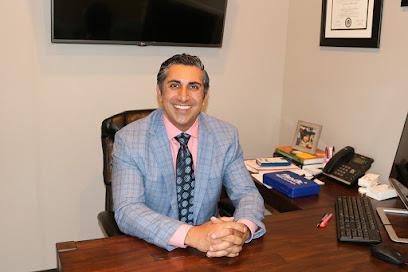
While actively expanding his practice, Dr. Hamidi also teaches as an adjunct clinical assistant professor at University of North Carolina (UNC) School of Dentistry, since he truly enjoys collaborating with the surgical residents-in-training on their challenging cases.
Dr. Hamidi holds memberships in many national and international dental organizations including The American Board of Periodontology, The American Academy of Periodontology, The International Team for Implantology, The Academy of Osseointegration, The American Dental Association, The Texas Dental Association and The Dallas County Dental Society. He is active in the Dallas community where he continues to serve and volunteer his time to treat underserved patients.
Dedicated to providing you with the best care available, Dr. Hamidi constantly advances his practice through continuing education by attending national and international meetings. My goal is to provide you with exceptional patient care in an environment equipped with the most cutting-edge diagnostic and clinical care. I am committed to excellence that surpasses your periodontal and implant surgical care to encompass your total well-being.
While not working, Dr. Hamidi dedicates most of his time training for elite mountain climbing expeditions. He does so by traveling nationally and internationally to some of the most remote places on Earth to experience sights only few ever to get to experience in their lives at such high altitudes. Mountains are very special, they have something magical about them. They can be so dangerous and yet make us feel so small and humble. After spending time surrounded by them or climbing them you will feel the urge to come back. Every mountain I have climbed has taught me at least one important life lesson.
My goal is to provide you with exceptional patient care in an environment equipped with the most clinically cutting-edge diagnostic and clinical care. I am committed to excellence that transcends periodontal and implant surgical care to encompass your total well-being.