

To make your surgery day go smoothly please ensure you read all pre-surgical information provided by Dental Hearts. Your surgery day will consist of your doctor reviewing your medical history, expectations, and post-operative instructions. Patients are usually in the office for around 90 minutes. At the time of extraction, the doctor will need to numb your tooth, jawbone, and gums that surround the area with an anesthetic. During the extraction process, you will feel pressure but shouldnt experience discomfort. The pressure is from the process of firmly rocking the tooth in order to widen the socket for removal. For teeth that are severely broken down, a small amount of bone may need to be removed around the tooth. This may be followed by the placement of a future in the area of the extraction.
Bone grafting is a recommended option if you plan to replace an extracted tooth with an implant. After a dental extraction, the bone naturally begins to resorb (melt away). The resulting bone loss can limit your choices for replacing the missing tooth. Grafting at the time of extraction has the highest success with regards to preserving the bone. Grafting can also be completed after extraction, although it often is more difficult to achieve the desired results. After placement of a graft, we allow 3-6 months of healing. During this time, the grafted bone fuses with your existing bone to create an optimal foundation for an implant. Grafting is performed with either your own bone, a sterilized bone from another person/animal, or bone substitutes.
To make your surgery day go smoothly please ensure you read all pre-surgical information provided by Dental Hearts. Your surgery day will consist of your doctor reviewing your medical history, expectations, and post-operative instructions. Patients are usually in the office for around 90 minutes. At the time of extraction, the doctor will need to numb your tooth, jawbone, and gums that surround the area with an anesthetic. During the extraction process, you will feel pressure but shouldnt experience discomfort. The pressure is from the process of firmly rocking the tooth in order to widen the socket for removal. For teeth that are severely broken down, a small amount of bone may need to be removed around the tooth. This may be followed by the placement of a suture in the area of the extraction.
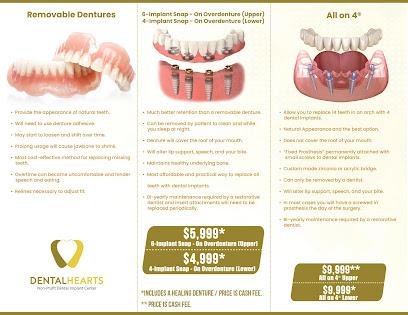
The All-on-4treatment conceptis a dental implant solution strategically designed for toothless jaws. If you are unhappy with yourdenturesor no longer want to live without teeth, itmight be the right solution for you.
Dr. M. Joe Mehranfar is one of the outstanding dental implantology practitioners in Arizona. After receiving an MS degree in microbiology from Southern Illinois University, Dr. Mehranfar completed his dental education at Temple University School of Dentistry in Philadelphia, Pennsylvania, followed by comprehensive implant training.
Dr. Mehranfar was formerly an Adjunct Assistant Professor at Midwestern University College of Dental Medicine in Glendale and A. T. Still University School of Dentistry and Oral Health in Mesa. Dr. Mehranfar was awarded a Mastership from the American Academy of Implant Prosthodontics. He is a member of the Board of Directors of the American Academy of Implant Prosthodontics and served as general chairperson of all annual meetings of the Academy since 2007 in Las Vegas, Phoenix, Mesa, Scottsdale, and Carefree.
Dr. Mehranfar is Chairperson-Elect of the implant division of the American Dental Education Association and a recipient of their Pierre Fauchard Award for excellence. He is also a member of the Board of Directors of the Central Arizona Dental Society.
Dr. Mehranfar was the director of dental implant education at the Brighterway Clinic in Phoenix, where he mentored residents from the Lutheran Medical Center of New York and instructed the live implant training at where clinicians from throughout the United States can obtain hands-on surgical training. Today, Dr.Joe is Clinical Director at Dental Hearts which specializes in helping the over 400,000 veterans in Arizona and those that have trouble affording conventional dental implant fees. Also, he isClinical Directorat Implant Education Company which trains U.S licensed dentists on live implant surgery.
Dr. Mehranfars practice extends to general dental offices throughout Phoenix, where he performs implant surgery for individual dentists. His own practice in Phoenix is limited to surgical andprosthodontic implant treatment.