


Dr. Deb Conner is a Durham, NC, endodontic specialist committed to your care. A graduate of UNC-Chapel Hill Dental School for both her DDS degree and her specialty MS degree (including her Endodontics Certificate), she is a native North Carolinian with deep roots in the Triangle area.
Each year while practicing dentistry and while earning her specialty degree, Dr. Conner attended continuing education programs throughout the country to improve her knowledge and skills. As a specialist, she continues to seek out the best continuing education available to stay current in her field and provide the best care possible to her patients.
While earning her specialty degree in Endodontics at UNC-CH, Dr. Conner's research involved using patient demographic and health data to study possible correlations between health issues (diabetes and high blood pressure) and endodontic treatment outcomes. She did not do any animal research during any of her studies.
Before her dental degrees, Dr. Conner earned a Master of Divinity from Duke University Divinity School and a Bachelor of Arts degree from Meredith College (in Raleigh) where she majored in Religion and English.
There is a huge amount of information about root canal treatments online. Some good, some not so much. The American Association of Endodontists (AAE) has accurate and complete information. We have copied (with permission, of course) some of the material to these pages and included links to the AAE site for more details. If you have any other questions, please feel free to call our office and ask.
We also compiled a lot of information from around the web in an unusual format -- a brain!. Here is a brain on endodontics and root canal treatment. (If you want to know more about the software we used to create it, go to www.thebrain.com.)

Endodontic or root canal treatment is necessary when the pulp, the soft tissue inside the root canal, becomes inflamed or infected. The inflammation or infection can have a variety of causes: deep decay, repeated dental procedures on the tooth, or a crack or chip in the tooth. In addition, an injury to a tooth may cause pulp damage even if the tooth has no visible chips or cracks. If pulp inflammation or infection is left untreated, it can cause pain or lead to an abscess (and bone loss).
Signs to look for include pain, prolonged sensitivity to hot or cold, tenderness to touch and chewing, discoloration of the tooth, and swelling, drainage and tenderness in the lymph nodes as well as nearby bone and gingival tissues. Sometimes, however, there are no symptoms (something to put in your gratitude journal the pain can be excruciating!).


To understand endodontic treatment, it helps to know something about the anatomy of the tooth. Inside the tooth, under the white enamel and a hard layer called the dentin, is a soft tissue called the pulp. The pulp contains blood vessels, nerves, and connective tissue and creates the surrounding hard tissues of the tooth during development.
The pulp extends from the crown of the tooth to the tip of the roots where it connects to the tissues surrounding the root. The pulp is important during a tooths growth and development. However, once a tooth is fully mature it can survive without the pulp, because the tooth continues to be nourished by the tissues surrounding it.

Endodontic treatment is necessary when the pulp, the soft tissue inside the root canal, becomes inflamed or infected. The inflammation or infection can have a variety of causes: deep decay, repeated dental procedures on the tooth, or a crack or chip in the tooth. In addition, an injury to a tooth may cause pulp damage even if the tooth has no visible chips or cracks. If pulp inflammation or infection is left untreated, it can cause pain or lead to an abscess.
The endodontist removes the inflamed or infected pulp, carefully cleans and shapes the inside of the canal, a channel inside the root, then fills and seals the space. Afterwards, you will return to your dentist, who will place a crown or other restoration on the tooth to protect and restore it to full function. After restoration, the tooth continues to function like any other tooth.
1. The endodontist examines and x-rays the tooth, then administers local anesthetic. After the tooth is numb, the endodontist places a small protective sheet called a dental dam over the area to isolate the tooth and keep it clean and free of saliva during the procedure.


3. After the space is cleaned and shaped, the endodontist fills the root canals with a biocompatible material, usually a rubber-like material called gutta-percha. The gutta-percha is placed with an adhesive cement to ensure complete sealing of the root canals. In most cases, a temporary filling is placed to close the opening. The temporary filling will be removed by your dentist before the tooth is restored.


If the tooth lacks sufficient structure to hold the restoration in place, your dentist or endodontist may place a post inside the tooth. Ask your dentist or endodontist for more details about the specific restoration planned for your tooth.
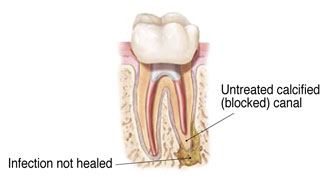
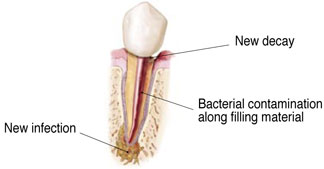
First, the endodontist will discuss your treatment options. If you and your endodontist choose retreatment, the endodontist will reopen your tooth to gain access to the root canal filling material. In many cases, complex restorative materialscrown, post and core materialmust be disassembled and removed to permit access to the root canals.

After removing the canal filling, the endodontist can clean the canals and carefully examine the inside of your tooth using magnification and illumination, searching for any additional canals or unusual anatomy that requires treatment.

After cleaning the canals, the endodontist will fill and seal the canals and place a temporary filling in the tooth. If the canals are unusually narrow or blocked, your endodontist may recommend endodontic surgery. This surgery involves making an incision to allow the other end of the root to be sealed.

After your endodontist completes retreatment, you will need to return to your dentist as soon as possible to have a new crown or other restoration placed on the tooth to protect and restore it to its full function.

Advances in technology are constantly changing the way root canal treatment is performed, so your endodontist may use new techniques that were not available when you had your first procedure. Your endodontist may be able to resolve your problem with retreatment.
The cost varies depending on how complicated the procedure will be. The procedure will probably be more complex than your first root canal treatment, because your restoration and filling material may need to be removed to accomplish the new procedure. In addition, your endodontist may need to spend extra time searching for unusual canal anatomy. Therefore, you can generally expect retreatment to cost more than the initial endodontic treatment.
While dental insurance may cover part or all of the cost for retreatment, some policies limit coverage to a single procedure on a tooth in a given period of time. Check with your employer or insurance company prior to retreatment to be sure of your coverage.
If nonsurgical retreatment is not an option, then endodontic surgery should be considered. This surgery involves making an incision to allow access to the tip of the root. Endodontic surgery may also be recommended in conjunction with retreatment or as an alternative. Your endodontist will discuss your options and recommend appropriate treatment.
The only other alternative is extraction of the tooth. The extracted tooth must then be replaced with an implant, bridge or removable partial denture to restore chewing function and to prevent adjacent teeth from shifting. Because these options require extensive surgery or dental procedures on adjacent healthy teeth, they can be far more costly and time consuming than retreatment and restoration of the natural tooth.
No matter how effective tooth replacements arenothing is as good as your own natural tooth. Youve already made an investment in saving your tooth. The payoff for choosing retreatment could be a healthy, functioning natural tooth for many years to come.