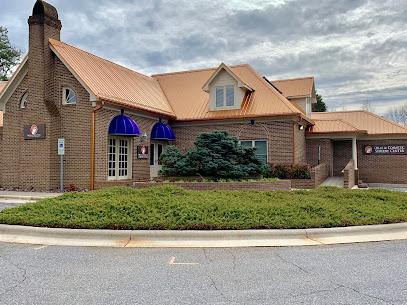


Originally from Potomac, Maryland, Dr. Christopher Brown received his Bachelor of Science in Dentistry at the University of North Carolina at Chapel Hill, then completed his dental education at the University of North Carolina and graduated with honors in 1986.
He served a 4 year residency in Oral & Maxillofacial Surgery at the University of Connecticut and subsequently began his career in private practice in North Carolina in the summer of 1990. He began the practice now known as the Brown, Neuwirth & Holt Oral & Cosmetic Surgery Center in 1993. Dr. Brown earned his board certification from the American Board of Oral & Maxillofacial Surgery. In 1994 Dr. Brown began practicing the full scope of Oral & Maxillofacial Surgery. Dr. Brown has presented and published both on national and international levels.

Dr. Bryan Neuwirth was born in California and raised in Missouri. After attending college at University of Missouri, he entered the UMKC School of Dentistry (University of Missouri-Kansas City), graduating with honors in 1987.
He began a residency in Oral & Maxillofacial Surgery at the University of North Carolina, earning his medical degree in 1991, again graduating with honors. He completed a general surgery internship at Carolinas Medical Center in Charlotte in 1992.
After his internship, he returned to Chapel Hill to complete his training in Oral & Maxillofacial Surgery in 1993. He continued his training by serving a one year fellowship in Cosmetic Surgery at the Cosmetic Surgery Center in Arkansas.
Dr. Neuwirth earned board certification from the American Board of Oral & Maxillofacial Surgery in 1996. He has memberships in several local, state and national societies in dentistry, medicine, Oral & Maxillofacial Surgery and Cosmetic Surgery, and has served as an officer as well. He serves as a clinical instructor for Western Piedmont Community College and lectures to residents and colleagues at the University of North Carolina. Presented and published on both national and international levels, Dr. Neuwirth practices the full scope of Oral & Maxillofacial Surgery with a specific clinical interest in cosmetic surgery.

1993 -1994 Cosmetic Surgery Fellowship; Cosmetic Surgery Center, Little Rock, AR; Certificate 1987 -1993 Oral & Maxillofacial Surgery Residency; University of North Carolina, Chapel Hill, North Carolina; Certificate 1991 -1992 General Surgery Internship; Carolina Medical Center, Charlotte, North Carolina; Certificate 1989 -1991 Medical School; University of North Carolina, Chapel Hill, North Carolina; Doctor of Medicine, Graduate of Distinction 1981 -1987 Dental School; University of Missouri, Kansas City, Missouri; Doctor of Dental Surgery, Graduate of Distinction
1994 Present: Brown & Neuwirth Oral and Cosmetic Surgery Center, Oral, Maxillofacial, & Cosmetic Surgeon 1993 -1994: Cosmetic Surgery Center, Cosmetic Surgery Fellowship 1987 -1993: University of North Carolina Hospitals, Oral & Maxillofacial Surgery Residency 1991 -1992: Carolinas Medical Center, General Surgery Internship 1981 -1984: UMKC Intramural Department, Referee
Our staff goes the extra mile to make every patient feel comfortable during their treatment with Brown & Neuwirth Oral & Cosmetic Surgery Center. They are experienced, certified oral and maxillofacial surgical assistants, who assist in administration of IV sedation, outpatient general anesthesia, and all surgical procedures. All staff members are informed administrative personnel, well-versed in health and insurance policies, and are CPR certified.
Each year Dr. Bryan Neuwirth dedicates one or more weeks of his time to serve the under-served of other countries. The team is normally organized of 25 members that serve in the dental clinic, medical clinic, pharmacy, and/or the childrens ministry team. Dr. Bryan Neuwirth and team have visited Nicaragua, Guatemala, and the Dominican Republic. Thanks in large part to the generosity of the community, the team is able to treat up to 500 patients per week and extract up to 1,200 decayed and abscessed teeth. The childrens ministry team interacts with over 500 children as well, by teaching a variety of Bible stories, games, songs, and crafts.
Our team consisted of 19 members (8 of which were 3rd and 4th year Dental students at UNC Chapel Hill) who served in the dental clinic. Our dental team was able to treat 238 patients in need, and extract over 550 decayed and/or abscessed teeth.
Over a period of time, the jaw bone associated with missing teeth atrophies and is reabsorbed. This often leaves a condition in which there is poor quality and quantity of bone suitable for the placement of dental implants. In these situations, most patients are not candidates for the placement of dental implants.
With bone grafting we now have the opportunity to not only replace bone where it is missing, but we also have the ability to promote new bone growth in that location. This not only gives us the opportunity to place dental implants of proper length and width, it also gives us a chance to restore functionality and aesthetic appearance.
Autogenous bone grafts, also known as autografts, are made from your own bone, taken from somewhere else in the body. The bone is typically harvested from the chin, jaw, lower leg bone, hip, or the skull. Autogenous bone grafts are advantageous in that the graft material is your own live bone, meaning it contains living cellular elements that enhances bone growth, also eliminating the risk of your body rejecting the graft material since it comes from you.
Allogenic bone, or allograft, is dead bone harvested from a cadaver, then processed using a freeze-dry method to extract the water via a vacuum. Unlike autogenous bone, allogenic bone cannot produce new bone on its own. Rather, it serves as a framework, or scaffold, over which bone from the surrounding bony walls can grow to fill the defect or void.
Xenogenic bone is derived from non-living bone of another species, usually a cow. The bone is processed at very high temperatures to avoid the potential for immune rejection and contamination. Like allogenic grafts, xenogenic grafts serve as a framework for bone from the surrounding area to grow and fill the void.
Both allogenic and xenogenic bone grafting have an advantage of not requiring a second procedure to harvest your own bone, as with autografts. However, because these options lack autografts bone-forming properties, bone regeneration may take longer than with autografts, and have a less predictable outcome.
This product is processed allograft bone, containing collagen, proteins, and growth factors that are extracted from the allograft bone. It is available in the form of powder, putty, chips, or as a gel that can be injected through a syringe.
Graft composites consist of other bone graft materials and growth factors to achieve the benefits of a variety of substances. Some combinations may include: collagen/ceramic composite, which closely resembles the composition of natural bone, DBM combined with bone marrow cells, which aid in the growth of new bone, or a collagen/ceramic/autograft composite
Synthetic materials also have the advantage of not requiring a second procedure to harvest bone, reducing risk and pain. Each bone grafting option has its own risks and benefits. Dr. Brown or Dr. Neuwirth will determine which type of bone graft material is best suited to your particular needs.