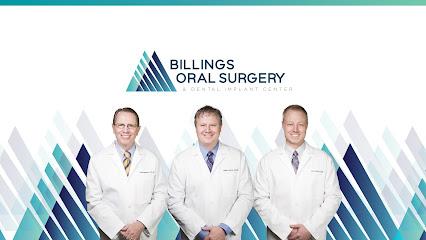


Sometimes, the fear of losing a tooth and living with an incomplete smile and decreased function can prevent patients from taking care of a dental problem quickly. Some patients will suffer from seemingly unbearable tooth pain because they do not know what the best solution is for providing immediate relief. Whether a tooth must be removed or it is already missing, dental implant placement is the best restorative solution to ensure the long-term health of the mouth. Oral and maxillofacial surgeons Dr. John Bennion, Dr. Andrew Boyce, and Dr. Kyle Tracy provide patients with a variety of restorative solutions utilizing dental implants that not only eliminate tooth pain but restore a beautiful new smile that patients will be proud to show.
They are changing the way people live. They are designed to provide a foundation for replacement teeth that look, feel, and function like natural teeth. The person who has lost teeth regains the ability to eat virtually anything and can smile with confidence, knowing that their new teeth appear natural.
Patients who undergo dental implant therapy find that the restoration offers a variety of benefits not offered by other forms of dental restoration, such as fixed bridges, removable partial dentures, and/or full-arch dentures.
Enhanced Aesthetics. Dental implant crowns are replicated to fit into every patients mouth uniquely so that the restoration looks just like the original, healthy tooth, thus allowing patients to smile with ease.
Increased Stability. They are made of medical-grade titanium, which fuses with the jaw bone during the healing period, creating the most stable restoration available and helping to ensure that the dental implant acts just like a natural tooth. Patients have no trouble biting into apples, eating chewy foods like caramel, or speaking and enunciating properly.
Maintain the Health of the Adjacent Teeth. When they are placed, there is no need to grind down or damage adjacent teeth to cement a bridge or utilize the strength of adjacent teeth to carry their burden. Additionally, they can be brushed and flossed like natural teeth, making it easier to maintain the health of the mouth and avoid tooth decay or periodontal disease.
Decreased Bone Loss. When a tooth is missing for an extended period of time, the jaw bone beneath the gums can begin to deteriorate. When dental implants are placed, the jaw bone fuses with the implant screw and maintains its natural contour.
During your first procedure, the implant will be placed, and you will need to wait a few weeks for the surgical site to heal and the implant to fuse with the jaw bone. After healing, when the implant is securely anchored in the bone, an abutment is attached to the implant and functions as the core of the replacement tooth. The abutment can be adjusted and shaped to allow the replacement tooth, or crown, to blend in with the adjacent teeth.
A single prosthesis (crown) is used to replace one missing tooth each prosthetic tooth attaches to its own implant. A partial prosthesis (fixed bridge) can replace two or more teeth and may require only two or three implants. A complete dental prosthesis (fixed bridge) replaces all of the teeth in your upper or lower jaw. The number you need varies depending upon which type of complete prosthesis (removable or fixed) is recommended. A removable prosthesis (over-denture) snaps onto attachments on the posts, whereas a fixed prosthesis is screwed in place and removable only by the dentist.
When you visit Billings Oral Surgery & Dental Implant Center, restoring your oral health and function is our top priority. Dr. John Bennion, Dr. Andrew Boyce, Dr. Kyle Tracy, and their entire team are dedicated to providing you with the personalized and compassionate patient care that you deserve.
Our office is comprised of multiple state-of-the-art surgical suites, a recovery suite, digital X-rays, and full instrument sterilization facilities. We use the latest surgical techniques and materials to provide our patients with the highest standard of care.

As oral and maxillofacial surgeons, our doctors specialize wisdom teeth removals and in the treatment of infections, injuries, or defects of the oral and facial region. In addition to earning a bachelors degree and completing four years of dental school, oral and maxillofacial surgeons complete four additional years of hands-on, hospital-based surgical training. Unlike many other practitioners, oral and maxillofacial surgeons are trained to administer anesthesia and offer a variety of anesthetic and sedative options in their practice.
Building a foundation of trust by treating our patients with personal, individualized care is vital to our success. We understand how uneasy some patients may feel about their dental visits and how we can make a difference in providing a relaxing and positive experience. Our entire team is dedicated to providing you with excellent personalized care and service to make your visits as comfortable and pleasant as possible.
Doctors John Bennion, Andrew Boyce, and Kyle Tracy at Billings Oral Surgery & Dental Implant Center are specialists in the removal of individual and multiple teeth. As oral and maxillofacial surgeons, this team has been highly trained to remove teeth quickly and easily and in a manner that minimizes recovery time. Whether you have an extra tooth, a damaged tooth, or a baby tooth that refuses to fall out, our doctors have an extraction solution for you.
When teeth become damaged by decay or break down due to trauma or wear, they can typically be restored with a filling, root canal, or crown. When the damage is too great, your dentist may decide that the best course of action is to have the tooth removed. If this is the case, your dentist will develop a plan for extraction, taking into consideration your age, health, and the overall condition of your mouth. Most tooth extractions can be performed in one surgical visit.
Crowding.There are times when seemingly healthy teeth need to be removed. Occasionally we are born with too many teeth, or our mouth is too small for all the teeth we have. In these instances, your orthodontist or general dentist may recommend that a tooth is removed.
Infection and Decay.If a tooth is decaying, it is important to have it treated in the early stages when it can be repaired with a dental filling. If left untreated, decay continues to spread and affect the integrity of your tooth, which may now require root canal therapy, a crown, or extraction.