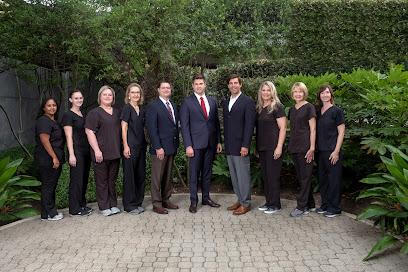


Dr. Andrew Verrett focuses on thetreatment of periodontal diseaseand restoration of function usingadvanced periodontal and surgical techniques. These include dental implants, advanced hard and soft tissue augmentation procedures, and regenerative periodontal therapies.
Dr. Verrett completed his residency in Periodontics and received his masters degree in Dental Science at Lackland AFB in San Antonio, Texas. He served six years in the Air Force as Chief of Periodontics in Elmendorf AFB in Anchorage, Alaska and taught the Periodontal Program for the AEGD residency at Travis AFB, California.
Dr. Verrett is board certified in Periodontics and Dental Implant Surgery as well as being a Diplomate of the American Board of Periodontology. He grew up in Texas where he attended The University of Texas at Austin for his bachelors degree in biology. Additionally, he obtained his dental degree at The University of Texas Health Science Center in San Antonio. Dr. Verrett enjoys an active lifestyle of travel, live music, and adventure.
Dr. Daniel S. O'Dell was born in Austin, Texas. He completed his undergraduate education as a Cum Laude graduate from Southwest Texas State University. Dr. O'Dell earned his Doctor of Dental Surgery degree with Magna Cum Laude standing from the University of Texas Health Center at San Antonio. He completed his specialty training and graduated with a Certificate in Periodontics and a Master's Degree in Periodontics from the Health Science Center at San Antonio. In addition to practicing periodontics, he is on staff at Seton Medical Center. Dr. O'Dell is Board Certified as a Diplomate of the American Academy of Periodontology and is an Active Member of the following associations:
Dr. Kyle T. Smith is originally from Houston, Texas. He attended Purdue University and graduated Cum Laude with advanced honors with a Bachelor's Degree in Biology. He then completed his dental training as a Dean's List graduate from the University of Texas Health Center at San Antonio with a Doctor of Dental Surgery Degree. He completed his specialty training at the University of Nebraska Medical Center in Lincoln, Nebraska, with a Master's Degree in Periodontics. Dr. Smith is a Board Certified Periodontist, having completed the highest level of recognition by the specialty. He continues to be very active in continuing education and attends the majority of the most respected periodontal Continuing Education meetings throughout the country. Dr. Smith is an Active Member of the following local and national associations:
On a Personal Note:Dr. Smith enjoys spending time with his wife and children. He also enjoys outdoor sports like biking and water skiing, the live music that Austin has to offer, and spends most of his personal time with family and friends. Interestingly, Dr. Smith is also an Eagle Scout.
One of their highest priorities is that you fully understand your course of treatment and that you are aware of all alternatives available to you. They will take the time to answer any questions you may have.
Traditionally, if you were missing a tooth or if one needed to be extracted, the healthy teeth on either side of the missing tooth would be reshaped and the missing tooth replaced with a three-crown bridge. A removable bridge might also have been used, but would often put undue forces on your remaining teeth.
Dental implants are the modern alternative. Instead of reshaping two perfectly healthy teeth, the practitioner inserts a dental post (dental implant) into the jawbone to replace your missing tooth root. This post becomes solidly fixed into your jaw, just as a tooth root would be. Your general dentist then places a crown onto this artificial tooth root that looks, feels, and functions like your natural teeth.
Dental implants can now be used to anchor partial and full dentures. This prevents the slipping, irritation, and pain associated with floating partials and dentures. It also prevents the tedious removal of dentures for overnight soaking and cleaning. Dental implants also eliminate the need for dental adhesives. This allows you to enjoy eating the foods you previously avoided. With dental implants, your partials or dentures are firmly anchored to the jawbone, causing them to feel much more like natural teeth.
Natural tooth roots and dental implant posts are fixed firmly in your jawbone. When you chew, these tooth roots and posts stimulate the jawbone and prevent it from shrinking. You may have seen a person who looked prematurely old because their jawbone had shrunk after wearing floating dentures. Dental implants help preserve your jawbone and appearance.
The Success Rate of Dental ImplantsAfter their healing period, the success rate of dental implants is between 94% and 98%. If you are a non-smoker with good oral hygiene, the percentage is closer to 98%.
Bone RegenerationA critical question in determining whether an implant can be placed is, Is there enough bone to support the implant? Fortunately, advanced bone regeneration techniques now make it possible to place many more implants than just 10 years ago.
Am I a Candidate for Dental Implants?Dental implant treatment begins with an evaluation by your general dentist who will determine if you are a good candidate for this procedure. If dental implants might be possible, he or she will send you to a periodontist for a placement evaluation.