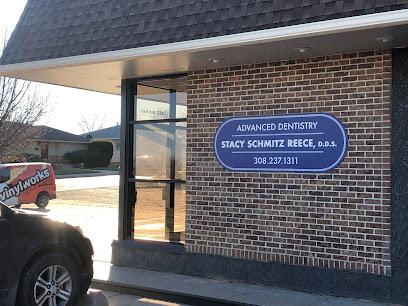


Dr. Reece was born and raised in Nebraska, grew up on a farm near Kearney, and graduated from Pleasanton High School. She completed her undergraduate studies at the University of Nebraska-Lincoln and graduated with a Bachelor of Science degree in Exercise Science in 2003. Dr. Reece then completed her Doctor of Dental Surgery degree at the University of Nebraska Medical Center College of Dentistry in 2007. After graduating from dental school in 2007, she moved to Anchorage, Alaska, and worked there as a general dentist for 10 years.
In Dr. Reeces practice, she loves building meaningful, long-lasting relationships with her patients. She immensely appreciates that she gets to see her patients regularly, watch them grow, educate them on how to improve their dental health, and make a difference in their lives. Dr. Reece is delighted to combine her knowledge of biology, her attention to detail, her artistic abilities, and her passion for helping people to create healthy and beautiful smiles.
When Dr. Reece is not at work, she enjoys spending time with her husband, Jonathan, and their four energetic and adorable children, Jack, Mae, Tilly, and Dottie. She enjoys walking, gardening, and helping on the family farm. As a family, they enjoy bike rides on the trails around Kearney, being outdoors, traveling, and exploring new places.
Rose Salvucci, nurse manager for the practice will be coordinating the class schedules. All inquires regarding schedules, availability, and cost should be sent to Rose. Rose can be reached by email at [email protected] or by calling (617) 332-2345, or on our Patient Gateway.
Minimally invasive surgery allows our physicians to use specific surgical techniques that limit the size and number of incisions that need to be made during a surgical procedure. As a result, they can perform surgery without cutting into a lot of skin and muscle, as is done with open gynecologic surgery. Less trauma to the muscles results in less pain, less blood loss, and quicker recovery times.
Typically, patients who undergo minimally invasive gynecologic surgery can return to normal activities within a few weeks. Oftentimes, patients can begin their physical therapy and recovery program sooner than patients who have had open gynecologic surgery, because their pain is less severe. Patients who have conventional (open) gynecologic surgery, typically, have a 6 week recovery period.
Curabitur ut velit lacus. Praesent sit amet sollicitudin orci, quis ullamcorper dolor. Praesent pellentesque magna ex, vitae suscipit nulla porta lobortis. Proin ac augue eu orci sollicitudin fermentum vel ultrices neque. Quisque a cursus dolor. Aenean fringilla, ipsum at eleifend euismod, nulla velit interdum nisi, sed aliquet risus magna sed justo. Aliquam pretium massa quis metus pulvinar, et congue nulla interdum. Etiam non aliquam nunc. Nulla tincidunt, enim non pellentesque eleifend, mauris nunc varius quam, sagittis ullamcorper lacus erat vitae massa. Sed viverra ante quis vestibulum varius.

Dr. Stacy Reece of Advanced Dentistry of Kearney has extensive experience performing tongue-tie release surgery. Tongue-tie, or ankyloglossia, is a condition present at birth that restricts the tongues range of motion. At birth, the lingual frenulum is unusually short, thick, or tight binding the bottom of the tongues tip to the floor of the mouth. For some infants, tongue-tie interferes with breastfeeding. If left untreated, tongue-tie can affect the way a developing child eats, speaks, and swallows.
Ordinarily, the lingual frenulum separates from the tongue before birth, but for some infants, the frenulum remains attached to the bottom of the tongue. It is not entirely clear why this happens, but for some infants, this may be due to genetic factors.
Some babies with tongue-ties and lip-ties are able to attach to the breast and suck well. However, many of these infants have breastfeeding problems. The following signs are common amongst infants with tongue and lip-ties and their mothers. However, it is important to note that these signs can be linked to other breastfeeding problems and are not solely related to ties.
Eating Problems. Tongue-tie can interfere with a childs ability to lick ice cream or a lollipop. Even licking the lips, or playing an instrument can be difficult for a child with a tongue-tie condition.
Frenectomy. A frenectomy involves the removal of the frenum from the mouth. Dr. Reece can perform this procedure with a pain-free laser treatment. The laser cauterizes the wound as it cuts, allowing for a short recovery period.
Because there are few nerve endings in the area to be cut, the patient may experience only mild discomfort. If your baby is rather fussy after the procedure, talk to Dr. Reece about prescribing over-the-counter pain medicine.
While a frenum cannot grow back, it can reattach if you dont follow the after-care exercises Dr. Reece gives you to stretch your babys lips and tongue in the weeks after the procedure. These exercises will help prevent frenulum reattachment.
Stitches are not normally required for tongue-tie laser surgery in infants, as the laser neatly and precisely cuts the soft tissue. In procedures with older children and adults, sutures are commonly placed.

At Advanced Dentistry of Kearney, we offer anesthesia-free dentistry with the Solea dental laser. With Solea, youll have an anxiety-free experience so there is no need to put off going to the dentist any longer.
About 95% of our cases are done anesthesia-free and blood-free, so you can leave the office without that uncomfortable, numb sensation, and get back to your day. In eliminating anesthesia, there is no injecting or waiting for numbness, so Dr. Reece can just sit down, get started, and complete all the dental work you need in just one visit.
The Solea dental laser operates at a unique wavelength with sophisticated, yet simple computer controls that enable high-speed, precision cutting on both hard and soft tissue. Solea works on everything from gingiva and dentin to enamel and bone.
Solea is cleared by the Food and Drug Administration (FDA) to cut enamel (teeth), soft tissue (gum), and bone. Some procedure examples include cavities, gingivectomies (gum surgery), frenectomies, aphthous ulcers, fibroma removals, crown lengthenings, and more.
Yes. The Solea all-tissue laser reduces dental aerosols and splatter by up to 99.9% compared to traditional handpieces, enabling safer, more efficient dentistry in post-COVID environments. In a Press Release dated May 19, 2020, Convergent Dental, Inc., developer of the industry-leading CO2 all-tissue Solea laser, this finding supports recent guidance provided by the American Dental Association (ADA), recommending dentists use clinical techniques that reduce aerosol productions as much as possible, as the transmission of COVID-19 seems to occur via droplets and aerosols.